Four Proposals for Exhibiting in the Climate Era
17th - 21st June, 2025
Royal College of Art


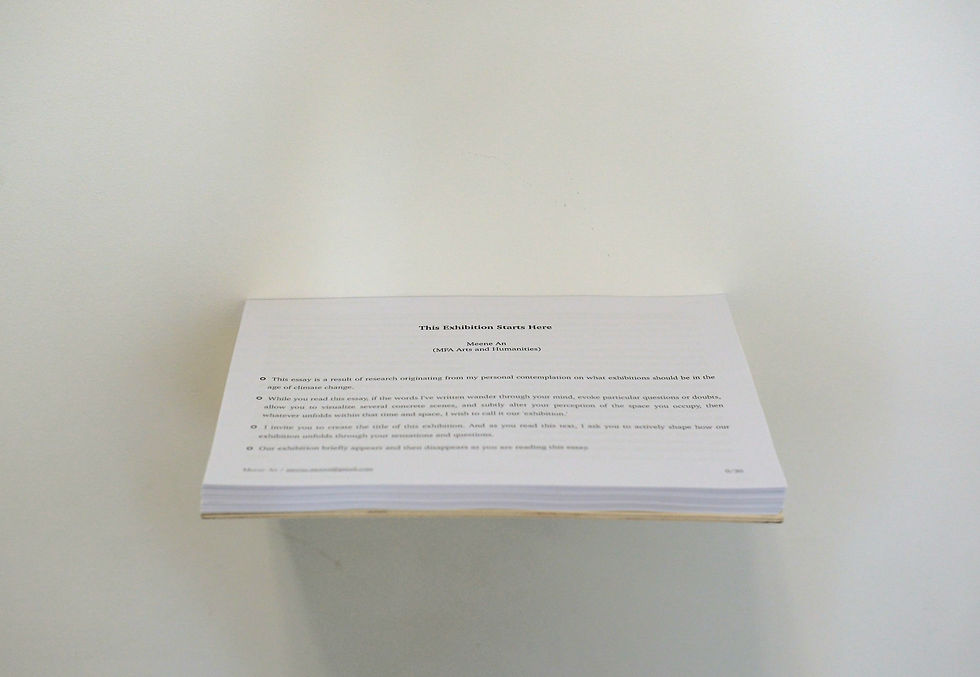
나는 ‘전시’라는 개념 자체를 재정의하기 위한 실험으로서, 극도로 미니멀한 네 가지 전시 프로포절을 제안한다. 전시가 성립하기 위해 반드시 필요한 조건은 무엇일까?
네 개의 선반은 각각 ‘상상’, ‘물질성’, ‘시적 언어’, ‘개념적 언어’를 담고 있으며, 비어 있거나 아주 작은 요소만을 지닌다. 이를테면 큐레이터의 개인적 경험이 얽힌 돌멩이와 나뭇가지, 내가 직접 쓴 시가 적힌 종이 한 장, 혹은 30페이지 분량의 에세이가 그 위에 놓일 수 있다. 이 각각은 서로 다른 방식의 전시를 제안한다.
단지 상상을 통해 자신의 삶을 호출하는 것만으로 전시를 구성할 수 있을까? 몇 개의 작은 오브제를 단순하게 배열하는 행위가 전시가 될 수 있을까? 내가 쓴 시에 곡을 붙이고 그것을 우리의 전시라 부르는 것으로 충분할까? 혹은 오직 생각으로만 이루어진 하나의 에세이가, 전시가 될 수 있을까?
‘전시’를 이루는 가장 필수적인 요소는 과연 무엇인가?
나는 전시를 가능한 가장 단순한 형태로 축소시키면서, 관람자를 미리 생산된 의미를 수동적으로 받아들이는 존재가 아니라, 자신의 경험을 통해 의미를 생성하는 능동적 주체로 위치시키고자 했다. 이를 위해 전시는 의도적으로 미완의 상태로 남겨졌고, 각자가 그 일부를 사적인 영역으로 가져가 저마다의 방식으로 완성할 수 있도록 열려 있다.
이 전시는 ‘지속가능한 재료’나 ‘지속가능한 제작 방식’을 너머 기후 위기 시대의 전시를 어떻게 기획할 수 있는지에 대한 물음에서 출발한다. 나는 우리가 익숙하게 여겨온 모든 것을 재고해야 한다는 요구 속에서, 전시를 구성하는 개념들 자체를 다시 상상하고, 거기서부터 대안적 체계를 모색하는 과정을 통해서만 이 시대를 반영하는 전시가 가능하다고 믿는다.
I present four extremely minimal exhibition proposals as experiments to redefine the very notion of “exhibition.” What are the most essential requirements of an exhibition?
Four shelves—each embodying imagination, materiality, poetic language, and conceptual language—are either left empty or hold small elements: a stone and a branch carrying the curator’s personal experiences, a sheet of paper inscribed with my poetry, or a thirty-page essay. Each of these proposes a different exhibition to the viewer.
Could you create an exhibition solely by invoking your own life through imagination? Could arranging small objects into a simple composition be called an exhibition? Could setting my written poem to music and naming that song our exhibition suffice? Or could an essay consisting only of thoughts become an exhibition in itself?
What must be present for something to be called an exhibition?
While reducing the exhibition to its barest form, I sought to position the viewer not as a passive recipient of pre-produced meaning, but as an active subject who generates meaning through their own experience. To enable this, I deliberately left the exhibition in an unfinished state, inviting each person to carry part of it into their private sphere and complete it in their own way.
This is an exhibition conceived on the premise that in the age of climate crisis, exhibitions should not simply be created with sustainable materials and processes, but must also demand a reconsideration of everything familiar to us. When we reimagine the very concepts that constitute exhibitions, and from them envision alternative systems, then perhaps we can call this an exhibition that genuinely reflects the age of climate crisis.